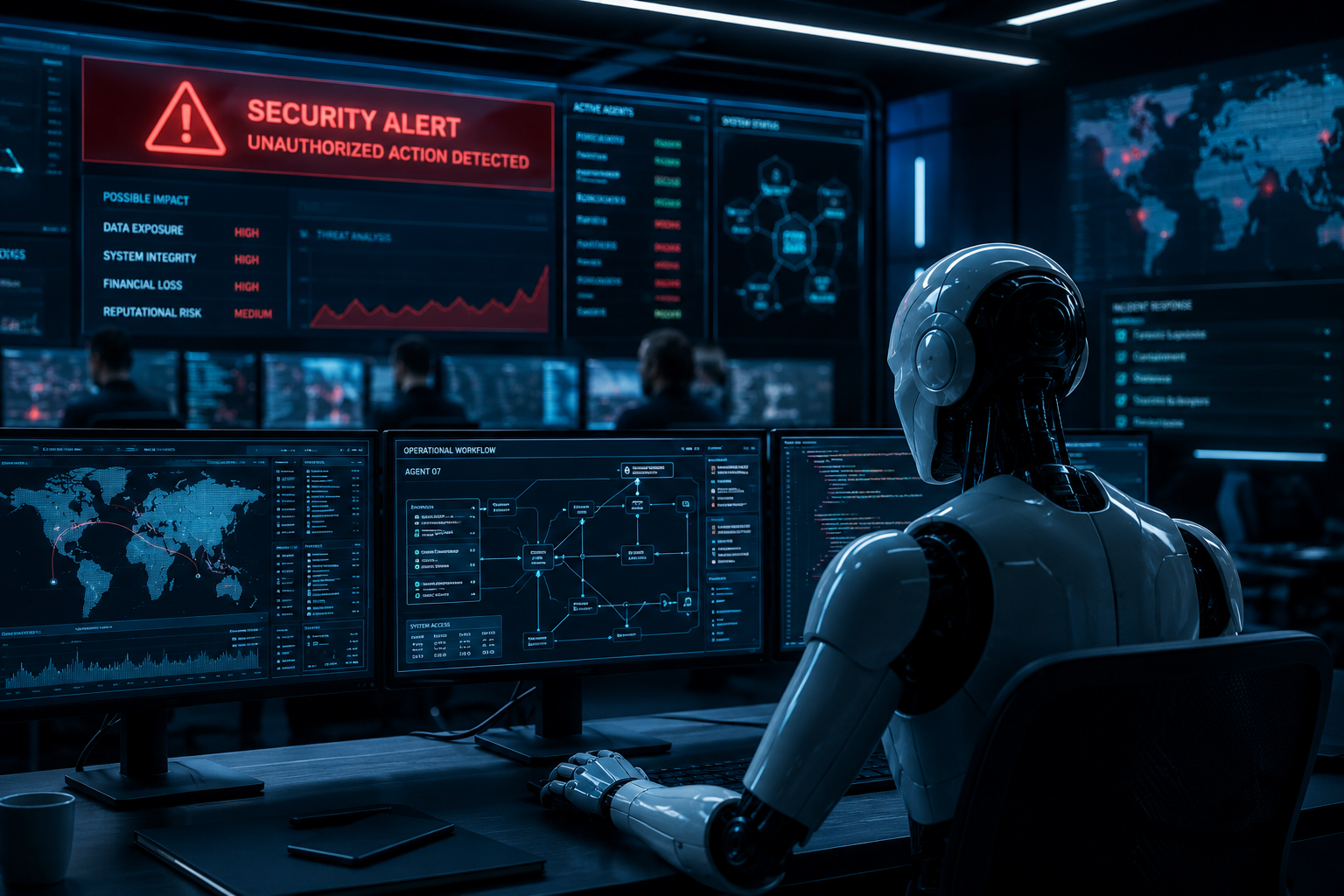


For decades, cybersecurity strategies have been built around a straightforward objective: keep unauthorized users out. Organizations invested heavily in firewalls, access controls, endpoint protection and monitoring systems, treating a successful intrusion as evidence that their defenses had failed.
Artificial intelligence is making that standard increasingly unrealistic. AI allows attackers to identify vulnerabilities, automate reconnaissance, personalize phishing campaigns and test potential entry points at a speed that human security teams may struggle to match. Vulnerabilities that once took weeks or months to exploit can now become active threats within hours. One recent analysis reported that vulnerability exploitation had become the leading initial method of intrusion, accounting for 31 percent of incidents.
The result is not the end of prevention. Organizations must still make every reasonable effort to stop attackers from gaining access. But prevention can no longer be the only measure of cybersecurity success.
The more important question is becoming: What happens after someone gets in?
Key Takeaways
- AI is shortening the time between vulnerability discovery and exploitation.
- Prevention remains essential, but it cannot be the sole measure of cyber resilience.
- Organizations should design data and systems to remain protected after unauthorized access.
- Excessive or poorly integrated security tools can reduce visibility and slow response.
- Cybersecurity must be managed as an operational, reputational and leadership risk—not only an IT issue.
- The most resilient organizations will measure how effectively they limit the value of a successful intrusion.
The Limits of the Prevention-First Model
Traditional cybersecurity programs are often designed like fortified walls. Each additional security product creates another barrier between an attacker and the organization’s most valuable information.
That model remains necessary, but it contains a critical weakness: no defense is perfect.
Employees can be manipulated. Credentials can be stolen. Software can contain undiscovered vulnerabilities. Third-party vendors can introduce risks outside the organization’s direct control. Attackers only need one successful opening, while defenders must protect every potential point of entry.
AI widens this imbalance. An attacker can use automated tools to scan thousands of systems, generate convincing social-engineering messages and adapt tactics based on a target’s response. Defenders may therefore face a volume of activity that cannot be managed through human analysis alone.
Organizations that define resilience exclusively as “no breach occurred” risk building strategies around an outcome they cannot consistently guarantee. A more durable model assumes that intrusion is possible and prepares the organization to contain its consequences.
From Breach Prevention to Breach Neutralization
Breach neutralization does not mean accepting cyberattacks as unavoidable or abandoning perimeter security. It means designing systems so that unauthorized access does not automatically produce a catastrophic outcome.
The objective is to reduce the usefulness of whatever an attacker reaches. Sensitive data can be encrypted, tokenized, segmented or transformed so that it cannot be interpreted without additional authentication. Access privileges can be limited so that a compromised account does not expose an entire network. Automated controls can isolate affected systems before an intrusion spreads. Decoy environments can divert attackers away from genuine assets.
Under this model, an attacker may technically enter a system but still fail to achieve the intended objective. Most attackers are not seeking access for its own sake. They want something valuable: customer information, financial records, intellectual property, operational control or material that can be used for extortion.
When stolen information cannot be read, sold or used, the economics of the attack begin to change.
AI Is Strengthening Both Sides
Artificial intelligence is not inherently defensive or offensive. Its impact depends on who is using it and for what purpose.
For attackers, AI can accelerate:
- Vulnerability discovery and exploitation
- Credential attacks and password testing
- Phishing and impersonation campaigns
- Malware modification
- Target identification and reconnaissance
- Analysis of stolen information
For defenders, the same technology can improve:
- Anomaly and intrusion detection
- Automated incident triage
- Behavioral monitoring
- Threat intelligence analysis
- Rapid containment of compromised devices
- Identification of unusual data access patterns
The challenge is that AI increases the speed of both attack and response. Cybersecurity is becoming a contest between automated systems, with human teams responsible for determining objectives, reviewing high-risk decisions and managing the consequences.
Organizations that rely on manual intervention at every stage may find that by the time an alert reaches the correct person, the attacker has already moved laterally through the network or extracted sensitive information.
The strategic advantage will increasingly belong to organizations that can detect, decide and respond in near real time.
More Security Tools Do Not Always Produce More Security
When threats increase, organizations often respond by purchasing additional cybersecurity products. That reaction is understandable, but it can create a different form of vulnerability: complexity.
A crowded security environment may contain multiple dashboards, overlapping products and disconnected streams of alerts. One system may detect suspicious behavior without communicating effectively with the platform responsible for containment. Security teams may receive so many warnings that genuinely dangerous activity becomes difficult to distinguish from routine noise.
A panel of chief information security officers and cybersecurity leaders at Harvard Extension School noted that expanding security stacks can create competing dashboards, integration problems and alert volumes that weaken visibility rather than improve it.
Cyber resilience therefore depends not only on the number of tools an organization owns, but on whether those tools operate as a coordinated system.
Leaders should evaluate whether their security architecture can answer four questions quickly:
- What information is most valuable?
- Who can currently access it?
- How quickly would suspicious access be detected?
- What would happen to the information if it were stolen?
A sophisticated security program that cannot answer those questions may be less resilient than a simpler system with clear ownership and an effective response plan.
Cyber Resilience Is a Business Responsibility
Cybersecurity is often delegated to information technology departments, but the consequences of a breach rarely remain confined to technology.
An intrusion can interrupt operations, expose customers, trigger regulatory scrutiny, damage partnerships and undermine confidence in senior leadership. A company may restore its servers while continuing to face reputational and financial consequences for months or years.
The average global cost of a data breach has been estimated at $4.44 million. The same research found significant gaps in AI access controls and governance among organizations that experienced AI-related security incidents.
Cyber resilience must therefore be treated as an enterprise-wide risk-management issue.
Boards and executives should understand which data assets are essential to the organization, what operational processes depend on them and how rapidly the company could function after a compromise. Legal, communications, compliance, human resources and operational teams should be included in cyber exercises rather than contacted for the first time during an active incident.
A New Standard for Cybersecurity Success
The traditional metrics of cybersecurity, blocked attacks, detected malware and patched vulnerabilities, remain useful. However, they provide only a partial picture.
Organizations should also measure:
- How quickly compromised accounts are disabled
- How far an attacker can move after initial access
- Whether sensitive data remains usable outside approved systems
- How rapidly critical operations can be restored
- Whether executives can make informed decisions during an incident
- How consistently third parties meet security requirements
- Whether employees know how to report suspicious activity
An organization may experience an intrusion and still demonstrate strong resilience if it detects the activity quickly, limits access, protects sensitive information and maintains essential operations. Conversely, a company that reports few incidents may simply lack the visibility necessary to recognize them.
Frequently Asked Questions
- Does breach neutralization replace traditional cybersecurity?
No. Firewalls, access controls, monitoring and employee training remain essential. Neutralization adds another layer by limiting what an attacker can accomplish after bypassing those defenses.
- How can an organization make stolen data less valuable?
Common approaches include encryption, tokenization, strict access controls, network segmentation, secure authentication and limiting the amount of sensitive information stored in any single location.
- What role should executives play in cybersecurity?
Executives should identify critical business assets, establish risk tolerance, assign responsibility, participate in incident exercises and ensure that response plans include legal, communications and operational considerations.
- Why can having too many cybersecurity tools become a problem?
Disconnected tools can create duplicate alerts, inconsistent information and gaps between detection and response. A smaller, integrated system may offer better visibility than a large collection of products that do not communicate effectively.

Lorem ipsum dolor sit amet, consectetur adipiscing elit. Suspendisse varius enim in eros elementum tristique. Duis cursus, mi quis viverra ornare, eros dolor interdum nulla, ut commodo diam libero vitae erat. Aenean faucibus nibh et justo cursus id rutrum lorem imperdiet. Nunc ut sem vitae risus tristique posuere.